
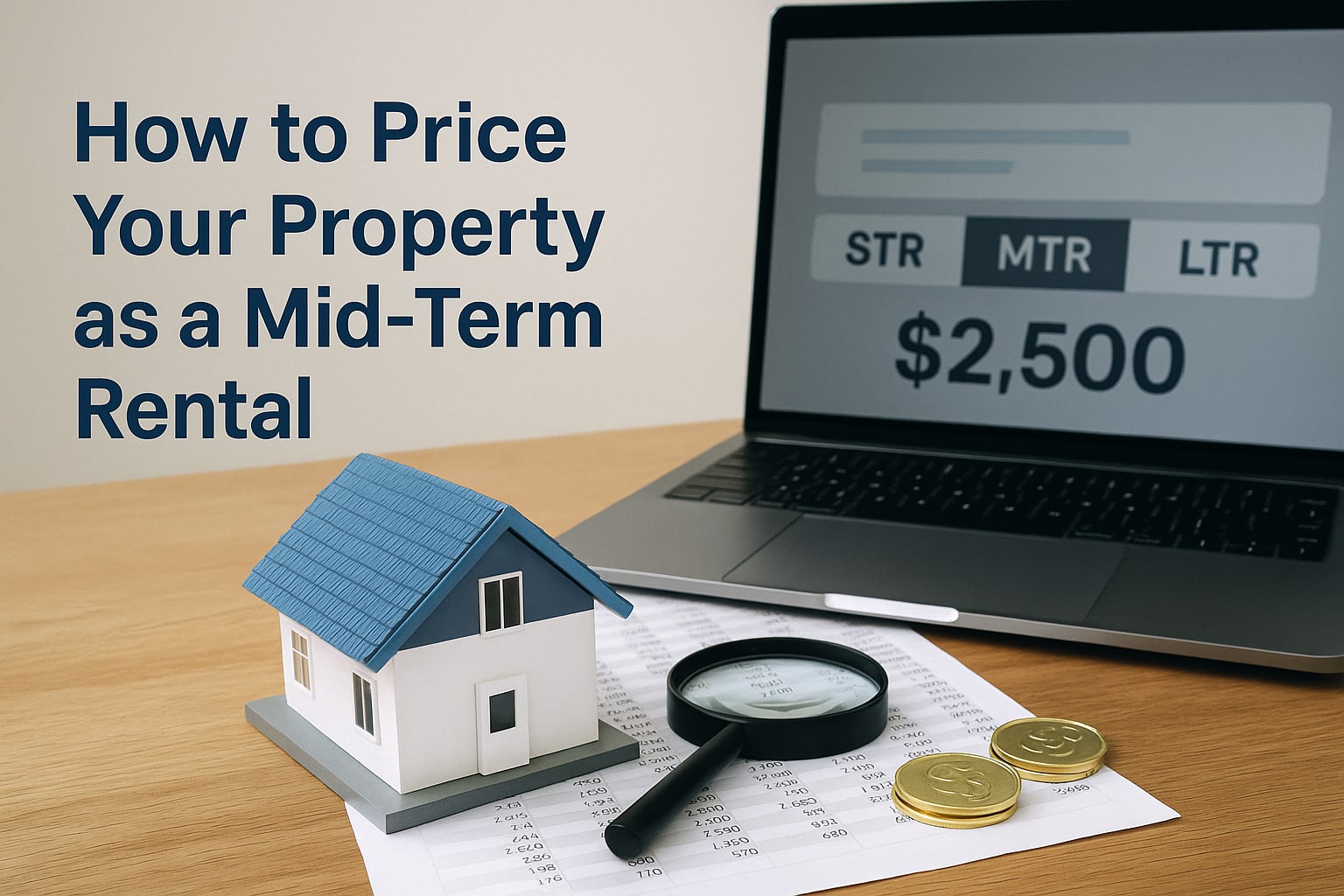
If you’re exploring ways to market your property as a mid-term rental (MTR), one of the first questions that comes to mind is: “How much should I charge?” Pricing can feel overwhelming — especially if you’re used to thinking in terms of nightly rates for short-term rentals (STRs) or monthly rent for long-term tenants.
The reality is that mid-term rental pricing isn’t one-size-fits-all. Your property’s location, furnishings, amenities, and local demand all play a role in determining the right monthly rate. That’s exactly why we created the Homads Rental Calculator — a free tool that lets you compare how much your property could make as a short-term rental, mid-term rental, and long-term rental, plus see how much you could earn from insurance housing (ALE).
In this article, we’ll break down everything you need to know about how to price your mid-term rental, including:
Why MTRs are one of the most profitable and stable rental strategies today
The key factors that affect pricing
How to use our calculator to run real estimates
Practical pricing strategies and mistakes to avoid
The hidden opportunity in ALE (insurance housing)
Let’s dive in.
---
Why Mid-Term Rentals Are a Smart Strategy
Before we get into the numbers, it’s important to understand why mid-term rentals are growing so quickly and why pricing them correctly matters.
Unlike traditional long-term rentals, MTRs are designed for stays of 1–12 months. They’re especially popular with:
Traveling nurses and medical professionals on assignment
Corporate employees relocating or on extended projects
Graduate students or visiting professors
Digital nomads and remote workers
Families displaced by insurance claims (ALE housing)
For hosts, this type of rental offers the best of both worlds:
Higher income potential than a long-term rental because units are fully furnished and include utilities.
More stability than a short-term rental because you’re not constantly chasing nightly bookings.
Lower turnover since guests stay for several months, meaning fewer check-ins and less wear-and-tear.
Less regulation stress compared to short-term rentals, which are often restricted in major cities.
In other words, mid-term rentals can unlock consistent cash flow without the headaches of nightly turnover — as long as you get your pricing right.
---
Factors That Influence Mid-Term Rental Pricing
When deciding how much to charge, it’s important to remember that pricing varies based on several factors. What works for a two-bedroom condo in downtown Austin may not work for a single-family home in the suburbs. Here are the biggest things to consider:
1. Location & Neighborhood
Location is always the biggest driver. Ask yourself:
Is your property near hospitals or medical centers?
Are there corporate offices, tech hubs, or universities nearby?
Is it accessible to public transportation or major highways?
Example: A furnished apartment near a hospital may be in high demand from traveling nurses, while a suburban house may attract insurance families needing temporary housing.
2. Furnishings & Amenities
MTR tenants expect a turnkey living experience. That means:
Fully furnished with beds, couches, tables, and chairs
Kitchen stocked with basic cookware and utensils
Wi-Fi included (non-negotiable for remote workers)
Utilities (electricity, water, gas) bundled in the price
Extra amenities like in-unit laundry, dedicated workspaces, or pet-friendly policies can justify higher rent.
3. Seasonality & Local Demand
Certain cities see cyclical demand spikes:
Medical rotations happen on fixed schedules.
Corporate relocations increase in the summer and early fall.
University towns attract visiting faculty or grad students around semester starts.
4. Comparable Market Rates
Think of MTR pricing as the sweet spot between STR and LTR.
STR nightly rate × 30 = Usually too high, not competitive for monthly stays.
LTR monthly rate = Usually too low, doesn’t account for furnishings/utilities.
Your MTR rent should fall in between these two numbers, leaning closer to STR in high-demand areas or ALE scenarios.
---
How to Use the Homads Calculator to Price Your Mid-Term Rental
Instead of guessing, you can run real numbers in minutes using the Homads Rental Calculator. Here’s how it works:
Enter your property details — basic info like location and property type.
Compare STR, MTR, and LTR estimates — see what your home could make under each rental strategy.
View projected MTR earnings — get a realistic monthly rate based on your market.
Unlock ALE potential — by entering your email, you’ll see how much insurance housing tenants could pay.
This step-by-step tool gives you a data-driven starting point to market your property, so you’re not underpricing or overshooting.
---
MTR Pricing Strategy Tips
Once you’ve got your baseline numbers, here are some strategies to maximize your rental income:
Don’t underprice: Remember that furnishings, utilities, and flexibility are built into your rent. Guests expect to pay more for convenience.
Offer discounts for longer stays: While your base rate should be competitive, you can offer slightly reduced pricing for 3–6 month leases to attract stable tenants.
Highlight unique value: Do you offer a home office setup? Covered parking? Pet-friendly options? These features can justify higher rent.
Stay flexible: Start with calculator insights, then adjust based on feedback from inquiries and bookings.
---
Common Pricing Mistakes to Avoid
Even experienced hosts make these mistakes:
Basing rent only on LTR comps → This ignores your furnishing, utility costs, and convenience factor.
Multiplying STR nightly × 30 → This often prices you out of the MTR market, leading to low occupancy.
Ignoring ALE potential → Insurance-covered tenants are often willing to pay above-market rates for speed, space, and flexibility.
---
The Advantage of ALE (Insurance Housing)
One of the biggest untapped opportunities for MTR hosts is ALE housing. ALE stands for Additional Living Expense, and it applies when families are displaced due to insurance claims (like a house fire or flood).
Here’s why ALE matters for hosts:
Premium pricing: Insurance carriers often cover higher-than-market rents.
Longer stays: ALE tenants may need housing for several months while their home is being repaired.
Reliable payments: Rents are backed by insurance companies, not individuals.
By entering your email into the Homads calculator, you’ll unlock insights into how much your property could earn through ALE tenants. For many hosts, this can be the difference between a good return and a great return.
---
Final Thoughts: Get Your Pricing Right from Day One
Pricing your property as a mid-term rental doesn’t have to be complicated — but it does require more thought than simply copying short-term or long-term rates. The key is to balance market demand with the value you’re providing as a fully furnished, flexible option for tenants.
Using tools like the Homads Rental Calculator gives you a clear starting point. From there, you can refine your strategy, test different price points, and even explore the lucrative ALE market.
👉 Ready to see what your property could make as a mid-term rental? Try the Homads Rental Calculator today and discover your property’s full earning potential.